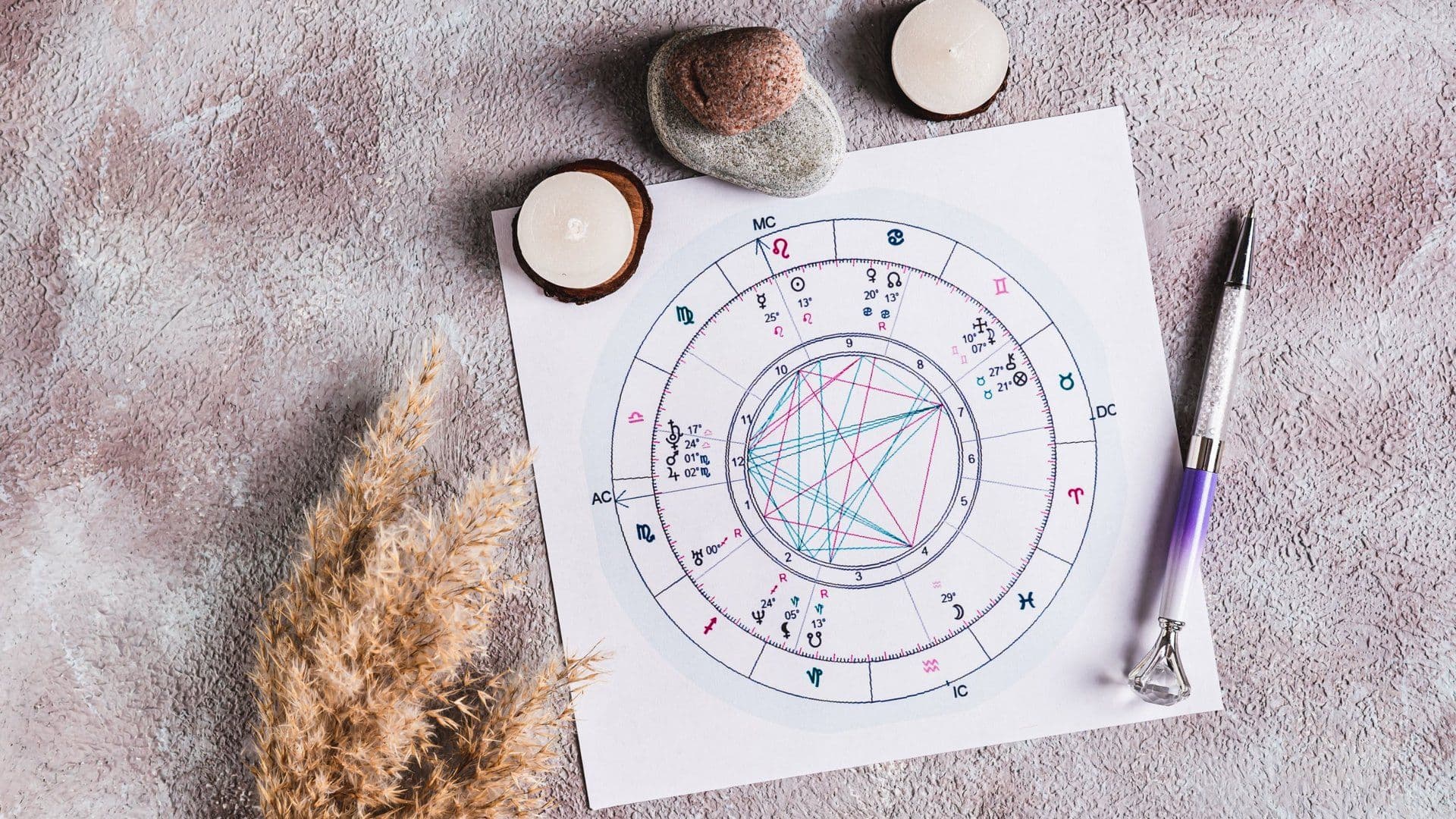
Open your birth chart. Look at where the planets are.
If four or more are concentrated in the same sign or in the same house, you have what's called a stellium.
And if you have one, you probably already know it. Even if you didn't know the name.
Because there's an area of your life that has always demanded more attention than the rest. A theme that keeps coming back, that insists, that won't leave you alone. A zone where things are more intense, more complicated, more alive.
That's a stellium.
What exactly is a stellium
A stellium is a grouping of four or more planets in the same zodiac sign or in the same astrological house of your birth chart.
Some astrologers use three as the minimum. But for me, a stellium starts at four. Why? Because three planets in the same sign can simply be a wide conjunction. Four is something else. Four planets together create a gravitational field that organizes the entire chart around that zone.
It's like having four spotlights aimed at the same stage. The rest of the chart doesn't disappear, but that area lights up with an intensity you can't ignore.
Sign stellium and house stellium: the difference matters
There are two types of stellium and they work differently.
A sign stellium means four or more planets share the same zodiac sign. This speaks to how you do things. The energetic quality that dominates your chart. If you have four planets in Virgo, your way of processing life runs through analysis, precision, and the need for things to make practical sense.
A house stellium means four or more planets share the same astrological house. This speaks to where the action concentrates. The area of life that absorbs the most energy. If you have four planets in the 7th house, significant relationships are the stage where everything happens.
Sometimes they overlap: four planets in Scorpio in the 8th house. Other times they don't: you can have a Capricorn stellium spread across the 9th and 10th houses. Both count. Both carry weight.
Which planets count
All planets count for a stellium: Sun, Moon, Mercury, Venus, Mars, Jupiter, Saturn, Uranus, Neptune, and Pluto.
But there's an important nuance. A stellium of personal planets (Sun, Moon, Mercury, Venus, Mars) is felt in daily life. In how you think, how you love, how you act. It's part of your personality in a direct and recognizable way.
A stellium that includes transpersonal planets (Uranus, Neptune, Pluto) has a generational dimension. If you were born in the 1980s, you probably share Pluto and Neptune positions with your entire generation. That doesn't invalidate it. But it changes the reading: it speaks of collective processes that touch you individually depending on the house where they fall in your chart.
The most personally revealing stellium is one that mixes both: a personal planet like Venus or Mars alongside Saturn and Pluto in the same sign. That's where the personal and the profound merge.
What a stellium means in each house
1st house. Your identity, your body, how you present yourself to the world. There's a very marked self-awareness. The person perceives themselves with intensity, for better and for worse.
2nd house. Resources, money, self-worth. The relationship with material things and with your own value is the central theme. There can be great capacity to generate resources or a very complex relationship with them.
3rd house. Communication, learning, immediate environment. A mind that never stops. A deep need to express, to move, to learn. Siblings or the local community may play an important role.
4th house. Home, family, roots. The inner world and origins are the center of everything. Private life carries enormous weight. The relationship with the mother or family of origin marks deeply.
5th house. Creativity, pleasure, children, romance. Creative expression and the capacity for enjoyment are amplified. Children, if any, occupy a central place in life.
6th house. Daily work, health, routines, service. The person organizes their life around what they do each day. Health can be a recurring theme. The need to be useful is intense.
7th house. Significant relationships, partner, associates. Everything is processed through the other. Relationships aren't a complement to life: they're the main stage. Learning to be alone without losing yourself is part of the work.
8th house. Transformation, crisis, sexuality, shared resources. Lives marked by processes of psychological death and rebirth. Nothing is superficial. What isn't transformed stagnates.
9th house. Philosophy, travel, expansion, meaning. The search for meaning is the engine. Long journeys, higher education, systems of thought. The question "what for?" is constant.
10th house. Vocation, career, public image. Professional life and social recognition absorb most of the energy. There's a deep need to leave a visible mark on the world.
11th house. Community, friendships, collective projects, ideals. The person fulfills themselves through groups, causes, or visions of the future. Friendship isn't accessory: it's structural.
12th house. Unconscious, spirituality, solitude, the hidden. A rich inner life. Processes that happen where no one sees them. There can be a natural connection with the intuitive, the artistic, or the therapeutic.
The shadow of the stellium
So much energy concentrated in one point carries a risk: everything else may be left empty.
If you have a stellium in the 10th house, your career can absorb so much that relationships, health, or your inner life get neglected. Not because they don't matter, but because the chart pushes so hard toward that area that everything else seems less urgent.
If you have a stellium in the 7th house, you might organize your entire life around your relationships and lose contact with who you are when there's no one beside you.
If you have a stellium in the 2nd house, the relationship with money and self-worth can become obsessive. Not out of greed, but because that's the area where your chart places all the pressure.
The shadow of the stellium isn't the stellium itself. It's unconsciousness. It's being so absorbed by that area that you don't realize you're there by inertia rather than by choice.
How to work with a stellium
The first step is to see it. To know that this concentration exists.
The second is to ask yourself: am I choosing this area consciously, or am I simply falling into it because that's where the energy carries me?
There's a vast difference between a person with a 10th house stellium who builds their career deliberately and the same person who sacrifices everything for work without realizing what they're losing.
A stellium isn't a sentence. It's a concentration of resources. What you do with those resources is up to you.
And the empty houses — those areas where you have no planets — aren't empty of meaning. They're governed by a sign and a ruler that does have a position in your chart. They simply don't demand the same amount of attention.
Stellium and transits: when everything activates at once
If you have a stellium, transits that touch it activate everything at once.
A slow planet like Saturn or Pluto transiting through the sign of your stellium will conjunct each of those planets, one after another. It can be a period of several years where that area of your life reconfigures completely.
A Capricorn stellium, for example, lived through 2008 to 2024 with Pluto transiting over the entire group. That wasn't a one-time transit. It was a long, deep, and systematic transformation of everything those planets represented.
When a transit touches your stellium, it's not an event. It's a process. And processes require patience and awareness.
Do you have a stellium in your chart? In which sign or house?
Calculate your birth chart for free and see where the energy concentrates.