This month you're going to hear about eclipses until you're sick of it. In the news, because on August 12 Spain lives through an astronomical event it hasn't seen in over a century. And on social media, because every eclipse drags along its own wave of dramatic headlines: brace yourself, something big is coming, don't make decisions, your life is about to change.
Maybe something curious happens to you with all this. On one hand it fascinates you: you're going to watch the sky darken in the middle of the day, or you know someone travelling north just for that. On the other, there's a part of you wondering whether you should be worried. Whether the eclipse is going to do something to you.
This article exists to separate those two things. First the facts, verified. Then, what psychological astrology can tell you about these two eclipses — the solar one on the 12th and the lunar one on the 28th — without predictions and without fear. Because an eclipse doesn't do anything to you. But it can show you something.
What will happen on August 12: the facts first
On Wednesday, August 12, 2026, at dusk, the Moon will pass completely between the Sun and a strip of northern Spain. It's a total solar eclipse, and it's historic in the literal sense of the word: the last total eclipse visible from Spain happened on August 30, 1905. No one walking this country today has seen one from here.
The path of totality — the zone where the Sun is fully covered — crosses the peninsula from west to east through its northern half and ends over the Balearic Islands. A Coruña, Oviedo, León, Bilbao, Zaragoza, Valencia and Palma are inside it. Madrid and Barcelona fall just outside: they'll see a deeply partial eclipse, with more than 99% of the Sun covered, but without that instant of sudden night that exists only within the path.
The times, according to Spain's National Geographic Institute (IGN):
| City | Start (partial) | Maximum | Situation |
|---|---|---|---|
| A Coruña | 19:31 | 20:28 | Totality (~76 seconds) |
| León / Oviedo | ~19:32 | ~20:29 | Totality (the longest in Spain, near 1 min 48 s) |
| Bilbao | ~19:33 | ~20:29 | Totality |
| Zaragoza | ~19:34 | ~20:30 | Totality |
| Valencia | ~19:36 | ~20:31 | Totality |
| Palma | 19:38 | 20:32 | Totality, with the Sun almost grazing the sea |
| Madrid / Barcelona | ~19:33 / ~19:36 | ~20:30 | Partial, over 99% |
There's a detail almost nobody mentions and it changes the experience: the Sun will be very low. Between 12 degrees above the horizon in Galicia and barely 2 in the Balearics. You need a clear horizon toward the west-northwest — the sea, a plain, a high rooftop. And you need certified eclipse glasses during all the partial phases: only during totality, and only within the path, is it safe to look without protection.
If you're in Latin America, this eclipse won't be visible from most of the continent. But wait until the end of the month: the second eclipse of August is seen better from the Americas than from Europe. We'll get to it.
What exactly is an eclipse (and why isn't there one every month)
Every month there's a New Moon: the Moon passes between the Earth and the Sun. But its orbit is tilted relative to the path the Sun traces across the sky, so it almost always passes a little above or below. No eclipse.
Twice a year, the New Moon coincides with one of the two points where both paths cross. Those points are called the lunar nodes. When the alignment is exact, the Moon's shadow touches the Earth: a solar eclipse. And about two weeks before or after, the Full Moon of that same stretch crosses the Earth's shadow: a lunar eclipse. That's why eclipses come in pairs, like this August.
In psychological astrology, that geometry matters. The nodes are the points where the Moon's path — the emotional, the inherited, the automatic — crosses the Sun's path — identity, conscious direction. An eclipse is a lunation that happens right at that crossing. It isn't magic: it's a New or Full Moon at its highest volume, whose theme tends to unfold over the following months rather than burning out in a day.
The eclipse at 20° Leo: the process it describes
The fact: the New Moon of August 12 happens at 20°02' Leo, near the south node, and it doesn't arrive alone. That day there are four bodies in Leo — the Sun and Moon embraced at the degree of the eclipse, and further back in the sign, Mercury and Jupiter. Leo, that month, is the most inhabited sign in the sky. Attention concentrates there.
Leo, as a process, is the building of an identity that dares to be seen. The child who shows their drawing waiting for the adult's gaze. The part of you that creates something — a project, a work, a family, a version of yourself — and needs it to exist before someone else's eyes.
And here's the nuance that defines this eclipse: it happens near the south node. In the psychological tradition, the south node points to the known, what you already master, what has perhaps become automatic. A solar eclipse on the south node doesn't ask what do you want to begin? but something more uncomfortable: what part of the way you're seen no longer represents you?
Think of it this way. We all build, at some point, a way of shining that worked: the role that earned us applause at home, at work, in the group. Over the years, that role can become a cage. You keep performing the character everyone liked, even though inside you're already someone else. This eclipse falls exactly on that theme: the difference between expressing yourself and performing for applause. Between the recognition that nourishes you and the validation you depend on.
It's not a threat. It's a question with a date. And it comes from someone who has it close: this eclipse falls less than five degrees from my own Sun in Leo. I too am going to watch it with the question in mind.
Where it touches you: the eclipse and your birth chart
Here astrology by Sun sign falls short, and it's worth saying plainly: reading "how the eclipse affects Leo, Taurus, Scorpio" is reading one twelfth of the story. What really places this eclipse in your life are two things in your birth chart.
The first: the house where 20° Leo falls. The houses are the areas of life. If the eclipse falls in your 10th house, the theme of visibility plays out in your career and public image. In the 4th house, in family and intimate territory. In the 7th, in how you show yourself — or hide — within your bonds. The same question, twelve different settings.
The second: whether you have planets or points between 15° and 25° of the fixed signs — Leo, Aquarius, Taurus, Scorpio. A Sun, a Moon, a rising sign in that zone turns this eclipse into something personal: not a background theme, but a direct conversation with a specific piece of your chart.
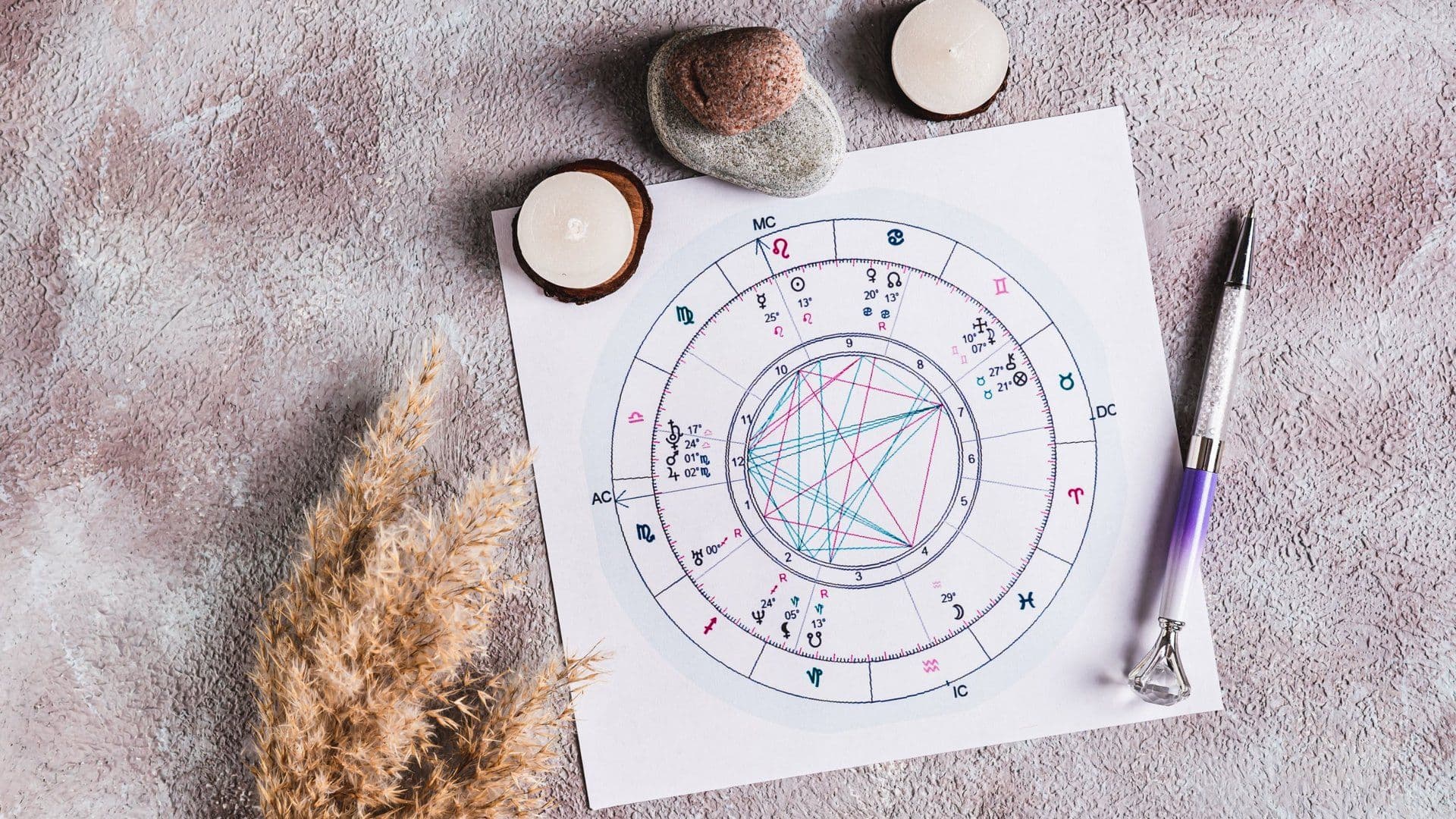
If you don't know where it falls, there's no need to guess. You can calculate your birth chart for free on this website and look for 20 Leo: the house where it lands tells you the setting, and the nearby planets tell you whether the function is speaking to you up close.
The second eclipse: the Full Moon in Pisces on August 28
Sixteen days later comes the other half of the pair, and it's easy for it to slip by unnoticed under the noise of the Spanish eclipse. That would be a shame, because symbolically it's just as eloquent.
The fact: in the early hours of August 28 (European time; the night of the 27th in the Americas), the Full Moon at 4°54' Pisces crosses the Earth's shadow. It's a partial eclipse, but so deep it grazes totality: more than 90% of the Moon will fall within the shadow. From the Americas it's seen fully and high in the sky — Venezuela will have it near midnight, Mexico and the Southern Cone in the middle of the night. From Spain it will be seen in the early morning, with the Moon already low toward the west, until it sets near dawn.
This eclipse happens on the Virgo–Pisces axis: the Sun in Virgo, the Moon in Pisces. And unlike the solar one, which opens a story, this one closes it. It's one of the last in a series of eclipses on this axis that began in September 2024 and fades out in early 2027. If you look back over these last two years, you'll probably recognize the theme: the tension between order and surrender.
Virgo is the part of you that manages: the schedule, health, method, control of the everyday. Pisces is the part that needs to let go of the wheel: to rest, to feel, to trust, not to have everything figured out. When one of the two devours the other, the body usually gives warning — the exhaustion of the one who never stops, or the chaos of the one who never lands. A Full Moon eclipsed in Pisces tends to put that tension right in front of you, with a clarity that everyday life doesn't always allow. What this Moon brings to light, it doesn't create. It only shows it.
And there's a piece of your chart that applies here too: if you have planets near 4–5° Pisces or Virgo, this second eclipse speaks to you more directly than the first.
August as a hinge: one story closes, another begins
Now put the two pieces together, because that's where the most interesting reading of the month lives.
The lunar eclipse of the 28th belongs to a series that is ending: Virgo–Pisces, the one you've been moving through since late 2024. The solar eclipse of the 12th, by contrast, belongs to a series that is just starting: Leo–Aquarius, which will accompany the sky until 2028. The lunar nodes have just moved onto that axis, and this is their first solar eclipse.
August 2026 is, literally, a hinge between two chapters. One that asks what you've learned about the balance between controlling and trusting. Another that begins to ask who you are when you're seen — and for whom you perform. You don't need to believe in anything esoteric to use that structure: it works the way a change of season works in your journal. A time frame for asking yourself better questions.
What an eclipse does not do
This section is the most important in the article, so I'm going to be very clear.
An eclipse predicts nothing. It doesn't punish, doesn't reward, doesn't "bring" breakups or force you into anything. The idea that you shouldn't make decisions, sign contracts or leave the house during an eclipse belongs to the territory of fear, and fear is exactly the opposite of what psychological astrology looks for: the difference between taking control away from your own life and giving it back to yourself.
There's also a simple way to check it with your own memory. Solar eclipses return to almost the same degree in regular cycles: in this same stretch of Leo there were eclipses on August 11, 2018, on August 11, 1999 — yes, that famous eclipse that crossed Europe —, on August 10, 1980 and on August 11, 1961. If you're old enough to remember '99 or 2018, ask yourself an honest question: did your life collapse those summers? Probably not. Was there, instead, some theme of identity, of visibility, of recognition moving underneath in that period? That's more interesting. That's the real scale an eclipse works on: the scale of processes, not catastrophes.
Astrology doesn't predict. It describes processes. And a process, unlike a sentence, always leaves you room to decide how you inhabit it.
How to live these eclipses: the practical and the symbolic
The practical, first. If you're in Spain and can get to the path of totality, do it: it's an experience this country hasn't offered since 1905 and that — apart from the one on August 2, 2027, which will repeat across the south — won't return for decades. Certified glasses for the partial phases, a clear western horizon, and arrive early, because half the country will have the same idea. If you're in the Americas, your date is the night of the 27th to the 28th: the eclipsed Moon needs no protection at all, just a reasonably dark sky.
The symbolic, after. You don't need any ritual. You need, if anything, fifteen minutes and two questions.
For the solar eclipse in Leo: in what part of my life am I still performing a character I no longer am, only because it's the one that gets applause?
For the lunar eclipse in Pisces: what have I spent two years trying to control that maybe only needs to be felt?
There's no right answer. There's your answer. And if while looking for it you get curious to see the full map — where exactly these degrees fall in your birth sky, which of your planets enter the conversation —, your birth chart is one click away, free, on this website. Calculate your birth chart for free.
And if you want to go deeper, there are two paths. I can read your whole chart and write it for you, with the areas that matter to you and the question you carry inside; you receive it in writing to return to. Your written natal chart. Or, if you prefer dialogue, we look at it together in a session. See the consultations. Both read the same sky; what changes is how you walk through it.
On August 12, for a little over a minute and a half, the Moon is going to cover the Sun over northern Spain. The symbol is beautiful even without astrology: what gives light can go dark for an instant, and the world doesn't end. It looks different. Sometimes that's enough to start looking at yourself differently too.
Where are you going to watch it from?
I don't do magic. I do awareness.