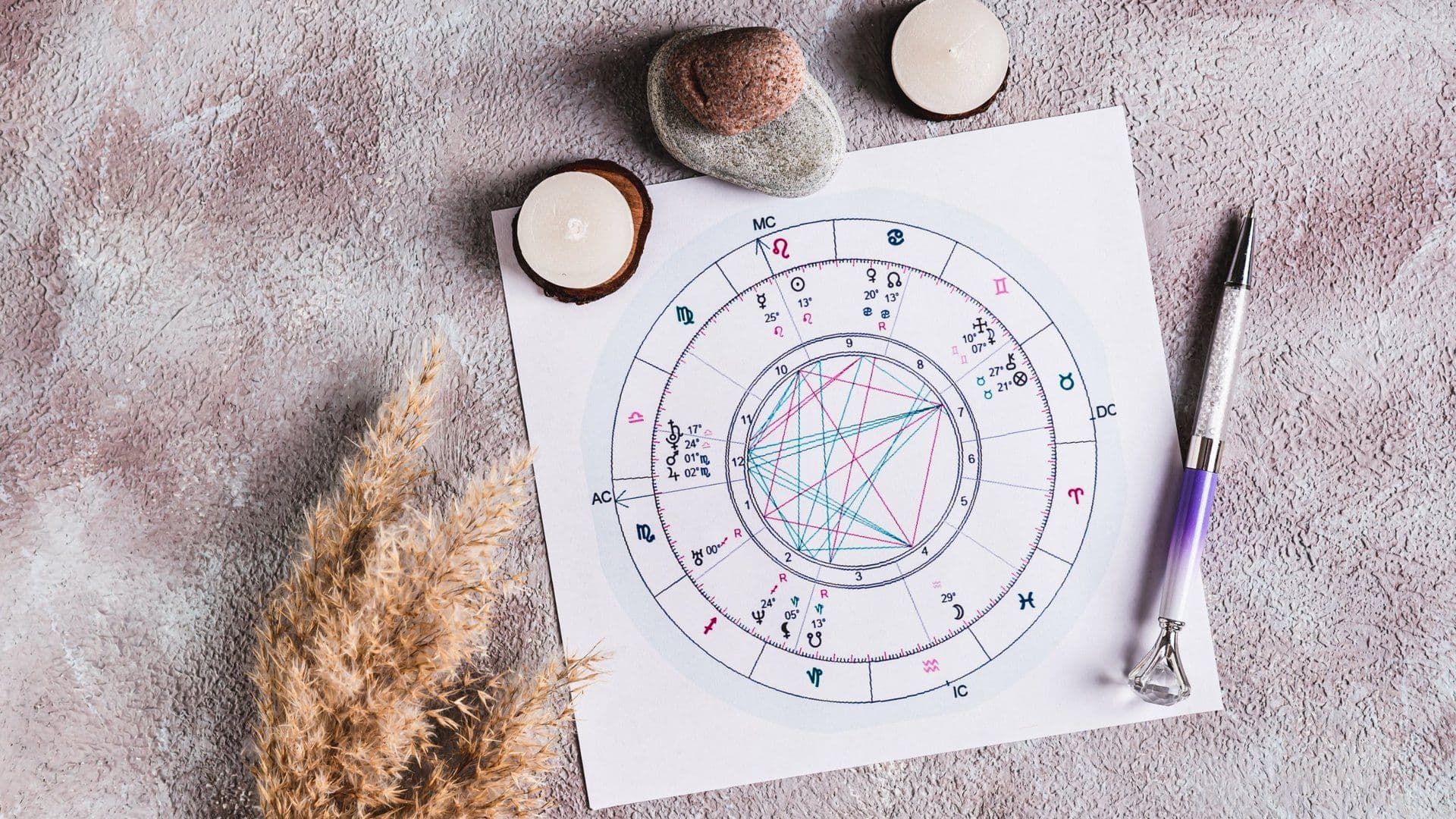
The first time someone opens their birth chart, the same thing usually happens. A wheel full of symbols and colored lines appears, and the natural reaction is to look for what you already know. The Sun. You type "Sun in Capricorn" into a search bar, read the description, then the one for your Moon, then the one for your rising sign.
When you finish, the feeling is strange. Each text describes a different person. One talks about someone reserved, another about someone who never stops talking, the third about a sensitivity with almost no skin. Which of these three portraits is me?
The chart is rarely the problem. The order is. This article doesn't walk through every piece one by one, that's what the free guide linked at the end is for. It suggests where to come in, what sequence to follow and which stumbles are most common at the start, with a sample chart so you can see it in practice.
Why does order matter so much when reading a birth chart?
Reading a birth chart means moving from the general to the specific. First you check that the map is reliable, then you look at where it concentrates, then you read the heaviest pieces together, and only at the end the relationships between planets.
You do the same with a city map without thinking about it. Before looking for a street, you find your bearings, see where the center is, where the river runs and which neighborhoods are big. If you start from a random corner, the corner is real, but you have no idea what city you're in.
So this doesn't stay abstract, we'll use an invented chart that belongs to nobody. Imagine a chart with Gemini rising and the Sun in Capricorn in the 7th house. The Moon is in Pisces, very close to the top of the wheel, and Mars in Aries sits at a ninety-degree angle to the Sun. We'll read it step by step, in the same order I suggest for yours.
Step one: check the birth time before interpreting anything
The quietest mistake at the start is reading a chart cast for an approximate time. "I was born in the morning", "I think it was around five". It looks like a detail, and it changes the whole map.
The rising sign, or Ascendant, is the sign that was coming up over the horizon at the moment of birth, and on average it changes sign every two hours. That average is a little misleading. In Madrid, for instance, some signs rise in just over an hour while others take close to two and a half. There are moments of the day when a half-hour error is enough to change your rising sign. All the houses move with it.
In our sample chart, if the real time were an hour and a half earlier or later, the rising sign could shift to Taurus or to Cancer. The Sun would leave the 7th house and land in the 8th or the 6th. The same person, told from somewhere else.
The Moon needs the time too, in a different way. It moves about thirteen degrees a day and changes signs every two and a bit days. If you were born on a day when the Moon was changing signs, the date alone isn't enough. Something similar happens with the Sun on the border days between two signs, which don't fall on the same date every year.
If you don't have your time, look for it on your birth certificate or ask your family. And if it doesn't turn up, the honest choice is to read what the chart can hold without it, the planets in their signs, and to put everything that depends on the horizon on hold. Reading less, and reading it well, is worth more than inventing half the map.
Step two: look at the shape before the details
With the time checked, it's still not time to read any planet. It's time to look at the wheel from a distance, like an aerial photo.
Notice where the planets pile up and where there are gaps. A chart with nearly everything in the top half isn't lived the same way as one with nearly everything below. When four or more planets gather in the same sign or the same house, it has a name, a stellium, and it usually marks the area of life that asks for the most attention.
Look too at which planets sit right next to the four angles of the wheel, the Ascendant on the left, the Midheaven at the top, the Descendant on the right and the IC at the bottom. In the tradition, a planet next to an angle expresses itself with more force and gets noticed more.
In our sample chart, the Moon in Pisces is almost on top of the Midheaven. That already says something. This person's emotional world doesn't stay at home, it comes out into view and mixes with their public life and their work. You can see what they feel.
One note so the gaps don't scare you. A house with no planets isn't a dead zone in your life. It's read through the sign on its cusp and the planet that rules that sign. It simply asks for less of the spotlight.
Step three: rising sign, Moon and Sun, read together
Here is the most common mistake of all, starting with the Sun and reading it as if it were the whole chart. The Sun carries real weight, but it's one layer. It describes where you're growing, the identity you're building, and sometimes it's the last thing a new acquaintance sees in you.
That's why I suggest a different order. First the rising sign, which is the front door, how you arrive and what others see before they know you (I explain it properly here). Then the Moon, what you need to feel safe. The Sun last, where you're heading.
Back to our sample chart. With Gemini rising, this person arrives asking questions, chatting, curious about everything. With the Moon in Pisces, they need to feel in tune with their surroundings, and they soak up whatever is going on around them. The Sun in Capricorn describes where they're growing, toward a structure of their own, something that lasts and holds up through effort. Read this way, nobody splits into three people. It's one person, with a light front door, a permeable inner world and a direction that asks for persistence.
The Sun's house adds the where. In the 7th, the territory of partnerships in the broad sense (couples, business partners, alliances), that structure is learned in relationship with others. For someone with this chart, a very concrete question tends to come up. What is mine, if almost everything I build, I build with someone else?
Step four: each planet in its sign and its house
Only now does it make sense to go through the rest of the planets. Each one reads like a three-part sentence. The planet says which function is at work, the sign says how it expresses itself and the house says in which area of life.
The typical stumble here is the textbook phrase. You search "Mars in Aries", find impulsive, competitive, direct, and stick it onto the chart like a label. Those phrases aren't lies, but they describe the piece in isolation. Read in order, Mars no longer arrives alone. It arrives in a chart that we know has a quick rising sign, a very porous Moon and a Sun that needs patience. That context changes the tone of any description.
A good habit is to write each planet in your own words before looking it up. Can't do it? Then that piece hasn't been read yet.
Step five: the aspects, last and without fear
Aspects are the lines that cross the center of the wheel. They show which planets talk to each other and in what tone. They come last because you can't read them well without first knowing who is talking to whom.
The mistake at this step is taking squares and oppositions as punishments. A hard aspect describes two parts of you pulling in different directions, which is why it tends to be where you work hardest and learn the most. Soft aspects, like the trine, point to what flows. Sometimes it flows so easily that it never gets developed.
In our sample chart, Mars in Aries square the Sun in Capricorn draws a recognizable friction. One part wants to start right now, and another knows that what's worth having gets built slowly. This person probably knows the scene well, starting something in a rush and feeling straight away that they're not living up to what they ask of themselves. The square doesn't sentence them to that scene. It names a tension that, handled well, gives drive and patience at the same time.
Other common beginner stumbles
There are three more worth keeping in view. The first is jumping to the most eye-catching points before you have the skeleton. Lilith, the asteroids or a house with a scary reputation are very tempting, and read before the basics they tend to scramble the reading.
The second is comparing two chart calculators and finding a planet in different houses. Neither one is wrong. There are several house systems, and when a planet sits near the border between two houses, each system may place it in a different one. The sensible thing is to pick one and always read with the same one.
The third is reading the chart as if it announced what's going to happen. The birth chart is fixed and describes the ground you arrived with. Over the years, transits move across it. They don't dictate events either, they describe processes you can work with.
When do you stop reading pieces and start reading a chart?
At some point the pieces start answering each other. The Moon on one side explains why the Sun is such hard work, the rising sign covers something the 7th house lets show. That's reading a chart. It doesn't happen on the first afternoon. It doesn't need to.
The same order works for someone else's chart. With a child's chart the entry point shifts, because in childhood the Moon shows before anything else, and I explain why in your child's birth chart.
What you can do starting today is go through your own chart in this order and write down, at each step, a sentence of your own. You'll be surprised how many apparent contradictions sort themselves out once you stop reading a chart like a list.
Your chart is not your destiny. It's your working material.
To keep the meaning of each piece close at hand, download the free guide "How to read your birth chart". It covers the three signs, the planets, the houses, the angles and the aspects one by one, plus a worksheet to fill in with your chart in front of you.
There's one thing I'd really like to know. Which of your three signs did you start reading yourself through, and did anything change when you put it next to the other two?
If you don't have your chart yet, you can calculate it for free on the website. With your birth time you'll also see your rising sign and your twelve houses. Without it, the calculator shows you the planets in their signs.