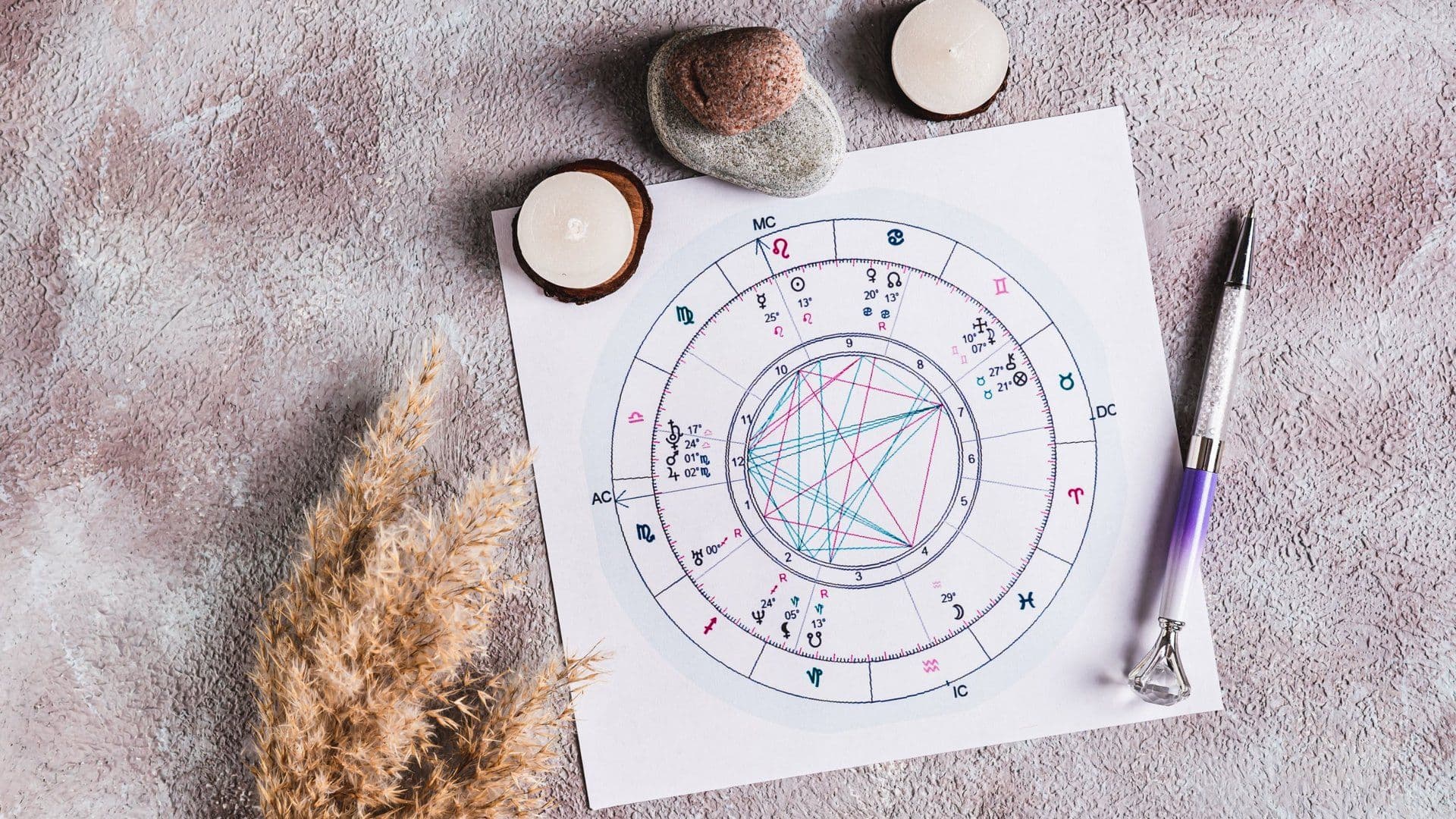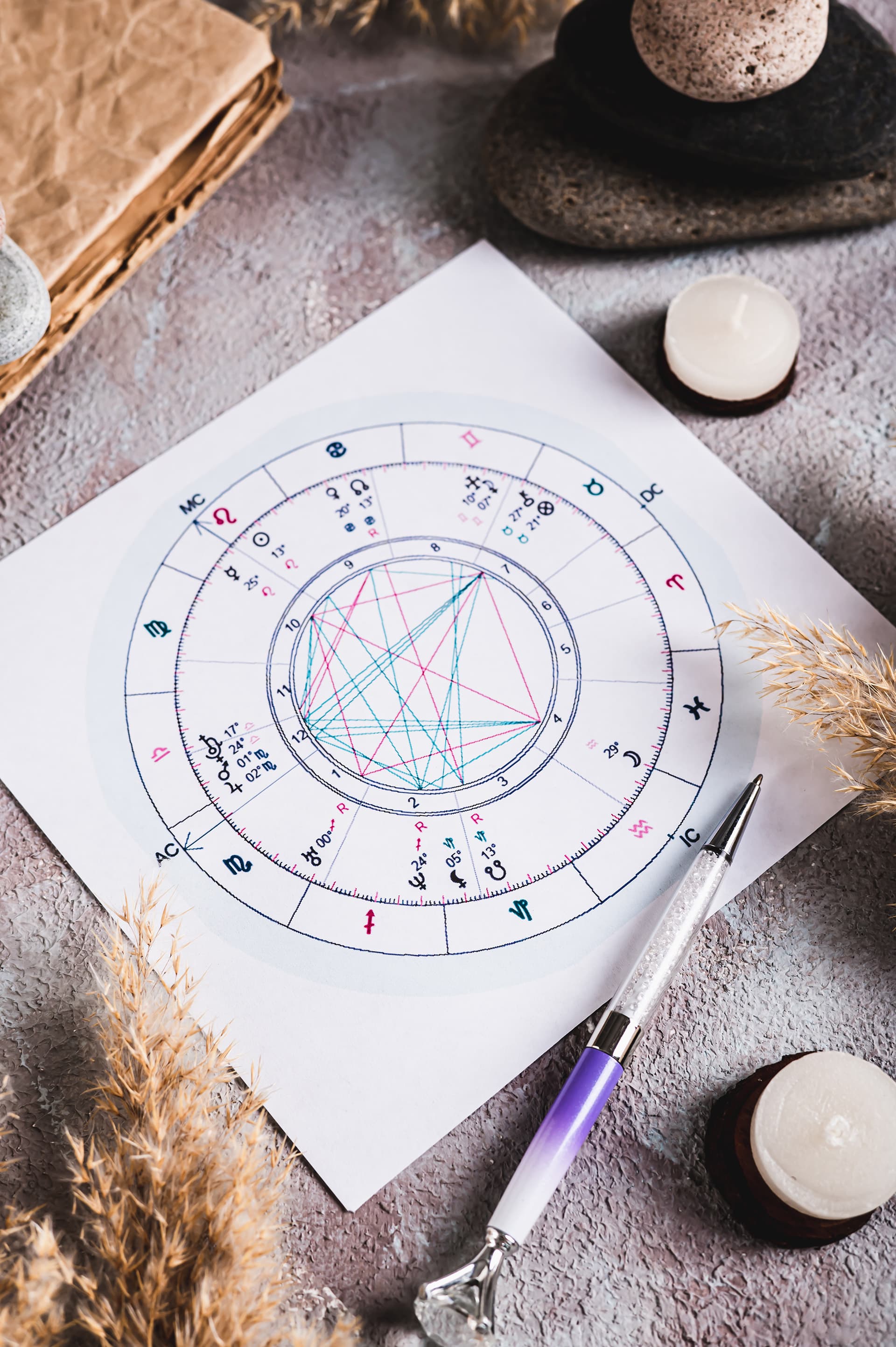
A natal chart is, literally, a photograph of the sky at the exact moment you were born. A map showing where each planet was, in which sign, in which house, and what relationships they formed with each other.
But it's not just frozen astronomy. It's a language. A symbolic system that translates planetary positions into psychological functions. And when you learn to read it — or when someone reads it with you — it becomes the most precise mirror you'll find of how your mind works.
The three axes of the natal chart
Everything in the natal chart is organized on three levels:
Planets — represent psychological functions. The Sun is conscious identity. The Moon, the emotional world. Mercury, how you think. Venus, how you love and what you value. Mars, how you act and what you desire. And so on.
Signs — represent how each function is expressed. A Sun in Aries expresses with impulse and urgency. A Sun in Cancer, with care and protection. Neither is better or worse. Just different.
Houses — represent where that energy manifests. The 7th house is the realm of relationships. The 10th, vocation and public image. The 4th, home and roots.
What do you need to calculate it?
Three pieces of data: birth date, exact time, and place. The date gives you the signs and slow planets. The time gives you the Ascendant and houses — that is, the complete structure. And the place allows for precise astronomical calculations.
Without the time, you can get a partial reading. But it's like seeing a map without the streets: you have the general terrain, but you're missing the detail.
What a natal chart is NOT
It's not a destiny. It doesn't say what will happen to you. It's not an extended horoscope. It doesn't classify you into a fixed personality type.
It's a map of possibilities. It shows tendencies, not certainties. It describes patterns, not events. And above all: it shows a starting point, not a destination.
Aspects: the conversation between planets
Beyond each planet's position, the natal chart shows relationships between them. When two planets are at a significant angle, they form an aspect. It can be harmonious (trine, sextile) or tense (square, opposition).
Tense aspects aren't "bad." They're areas where there's friction, where you need to work on something, where growth is more uncomfortable but also deeper. Harmonious aspects are natural talents — but also comforts that sometimes you don't develop because you don't need to try.
Why does it matter?
Because it gives you a language to talk about yourself without judgment. Because it turns "I'm too intense" into "I have Pluto aspecting my Sun and I need depth to feel alive." It turns "I can't commit" into "I have Uranus in the 7th house and I need freedom within relationships."
It doesn't tell you what to do. It tells you what you're working with. And that, in my experience, changes the way you relate to yourself.
Can you read it yourself?
You can learn the fundamentals. But a natal chart has hundreds of possible combinations. Reading it well requires synthesis — seeing the whole, not just the individual parts. That's why a consultation isn't a lecture: it's a conversation where we integrate everything the chart says in the context of your real life.