There's a moment almost everyone has lived, though few people admit it. You meet someone who matters to you, you find out their sign, and that same night you're searching "Leo and Pisces compatibility" on your phone. Or you've been with your partner for years and, after the same argument as always — number two hundred, identical to the first —, you wonder whether there's something between the two of you that simply works this way. Something you could name.
Astrology has a serious tool for that question. It isn't the list of compatible signs from the magazines. It's called synastry, and it's probably the worst-explained technique in all of astrology, caught between promises of destiny it can't keep and compatibility tables that stay on the surface.
This article explains what it really is, what's compared when it's done well, and — just as important — what it can't tell you. Because a synastry doesn't answer whether that person is the right one. It answers something more useful: how two ways of being in the world touch.
What is synastry?
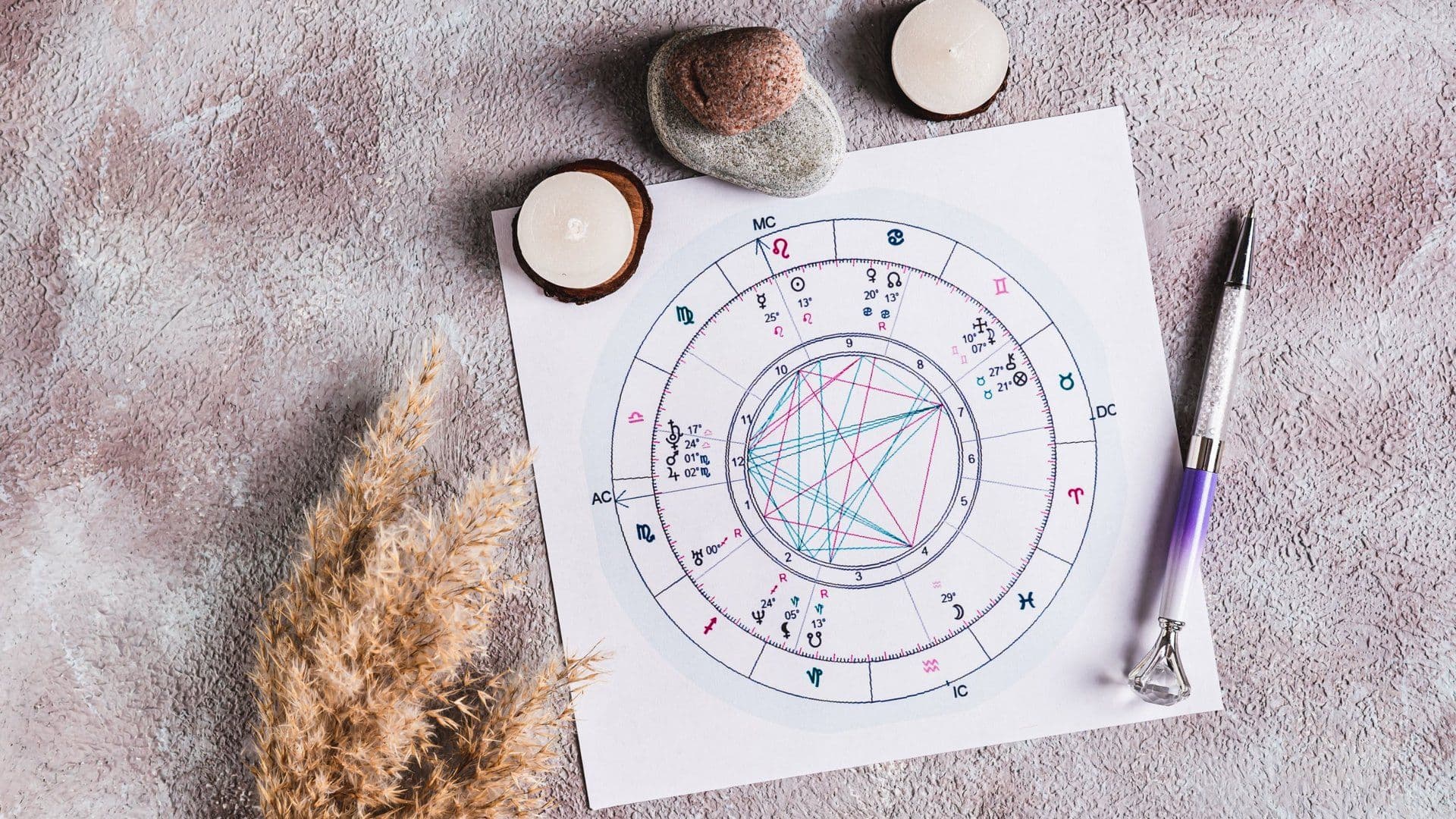
Synastry is the comparison of two complete birth charts. One person's chart is laid over the other's and you study how they interact: which planets of one touch which planets of the other, and in which areas of each life the other's presence lands.
Notice the key word: complete. It doesn't compare two signs. It compares two entire skies — the Sun, the Moon, the ascendant, Mercury, Venus, Mars and everything else in each person —, because each of those points describes a different function of how someone loves, argues, commits or protects themselves.
And although people almost always think of romantic couples, synastry works for any bond where two charts coexist: a business partnership, the relationship with your mother, with your child, with that friendship that's really family. The technique is the same; what changes is the question you ask it.
Why sign compatibility falls short
Here it's worth being honest about something popular astrology itself has fed for decades: compatibility by Sun sign — Aries doesn't work with Cancer, Taurus does with Virgo — is such an extreme simplification that it borders on useless.
The Sun sign is one layer of the chart. One. When you fall in love with someone, you don't fall in love with their Sun: you fall in love with a whole chart. With how they listen when you're low (their Moon), how they talk with you until three in the morning (their Mercury), how they look at you (their Venus, their Mars), how seriously they take what they promise (their Saturn). Two people with "incompatible" Sun signs can have their Moons in perfect harmony — and feel at home with each other from the first day. And two signs "made for each other" may not have a single real bridge between their charts.
That's why the question "are we compatible?" asked by signs has no serious answer. The question that does have an answer is another one: where do our charts touch, and what does each contact produce?
What's compared: the interaspects
When two charts are laid over each other, the planets of one form angles with the planets of the other. Those angles are called interaspects, and they're the technical heart of synastry.
They work just like the aspects within an individual chart — conjunctions, trines, sextiles, squares, oppositions —, but between two people. Your Moon trine their Venus. Their Mars square your Mercury. Each contact describes a specific current that exists between the two of you: where the relationship flows without effort, and where it chafes.
Two things matter here, and both contradict what you've probably read.
The first: in an interaspect, each person embodies their own planet. If your Saturn touches your partner's Sun, you tend to occupy the role of Saturn in that dynamic — the one who structures, who sets limits, who sometimes cools things down — and your partner the Sun's: the one who shines, who expands, who at times feels held back. Seeing the distribution of roles already changes the conversation: it stops being "you're like this" and becomes "this is what gets activated between us."
The second: tense aspects condemn nothing. A square between charts is not a sentence; it's friction, and friction has two faces. It's the recurring argument, yes. And it's also the engine: the relationships that transform us are almost never the ones that don't chafe at any point. What decides whether that tension wears you down or makes you grow isn't in the chart. It's in the awareness with which two people work it.
The five contacts that carry the most weight
In a serious synastry everything is examined, but not everything weighs the same. The personal planets — the ones that describe the day-to-day of how someone feels, speaks and desires — outrank the rest. This table sums up which question each one answers:
| Contact | The question it answers |
|---|---|
| Moon with Moon (and Moon with personal planets) | Can we live together emotionally? Do we calm each other or unsettle each other? |
| Venus and Mars | Is there attraction? Does what each one desires match what the other offers? |
| Mercury | How do we talk — and above all, how do we argue? |
| Sun | Do our life directions support or compete with each other? |
| Saturn | Can this last? Does commitment hold or does it squeeze? |
Two of them are worth pausing on.
The Moon is the contact of living together. It describes what each person needs to feel safe, and Moons in good dialogue explain those couples who maybe don't share hobbies or friends but rest in each other. When Moons clash, on the other hand, what one does to calm down can be exactly what unsettles the other — and neither of them understands why.
Saturn is the great misunderstood one. It has a reputation as a cold planet, and in synastry it's the glue: Saturn's contacts with the other's personal planets show up again and again in bonds that last, because they bring structure, patience and a sense of mutual responsibility. Its shadow exists — the same contact can turn into control, criticism, the feeling that the other is correcting your life —, and naming that double face is precisely the work: the glue and the cage are the same aspect, lived with different awareness.
The houses: where the other lands in your life
The interaspects tell half the story. The other half is the house overlays: in which area of your chart the other person's planets fall.
The image that explains it best is this: when someone's planet falls in a house of yours, it's as if that person were a permanent transit through that area of your life. Someone whose Sun falls in your 10th house lights up — whether they mean to or not — your professional theme: they push you, inspire you or challenge you there. Someone whose Moon falls in your 4th house settles into your intimate territory with a naturalness even you can't explain.
There are especially eloquent overlays. Someone's personal planets falling in your 7th house — the house of partnership and agreements — often mark a person you feel as a potential serious bond, almost from the start. And someone's planets in your 12th house touch your least visible zone: it can be a profound intimacy or a diffuse discomfort that's hard to name — astrologers have been debating that house for decades, and honesty requires saying that there, nuance matters more than the rule.
A technical note I can't spare you: the houses require the exact birth time of both people. Without the time, synastry is left only with the interaspects — it still says a great deal, but it loses the map of where each thing lands.
What synastry does not do
And we reach the section that matters to me more than all the previous ones.
A synastry doesn't tell you whether that person is the right one. It doesn't predict whether the relationship will last, doesn't calculate success percentages, doesn't detect future infidelities or warn you of breakups. Everything you may have seen along those lines — and online there's plenty — belongs to the territory of fortune-telling, not to the astrology I practice.
I'll tell you this from consultation experience too: I've seen synastries full of tensions sustain relationships of decades, built precisely on the conscious work of those frictions. And I've seen harmonious synastries — the kind that in theory have it all — dissolve in months, because ease without will doesn't sustain anything either. I always tell it as a composite of many real consultations, never a specific case, but the pattern is constant: the chart shows the terrain; the walking is done by two people.
That's exactly what a well-made synastry does offer, and it's not little. Putting a name to the dynamic they've spent years repeating without understanding. Seeing the distribution of roles that neither chose consciously. Telling which frictions are structural — they'll always be there, and you learn to dance them — and which are of a stage. The difference between taking control away from your own life and giving it back to yourself.
Synastry and the composite chart: they're not the same
A brief distinction, because you'll see them mentioned together: synastry compares two charts; the composite chart builds a third — the chart of the relationship itself as an entity, calculated from the midpoints of both. They're complementary techniques that answer different questions: synastry explains how the other affects you; the composite, what kind of creature the two of you have created between you. In consultation both are usually examined, always starting with synastry.
How a serious synastry is done
Three conditions separate a real synastry from an internet game.
First, the exact data of both: date, time and place of birth. And here a note I find non-negotiable: the other person's data is asked for, not dug up. A synastry done behind someone's back starts crooked before the first calculation — not out of superstition, but because the purpose of the tool is mutual understanding, and there can be no unilateral mutual understanding.
Second, each chart is read separately first. You can't understand how your partner's Saturn affects you without first understanding what Saturn does in their own chart. Synastry is a dialogue between two texts: you have to know how to read each text before reading the conversation.
And third, it's read as a process, not a verdict. The opening question is never "are we well matched?" but "what gets activated between us, and what do we do with it?"
If this resonates, the natural order is to start with you: you can calculate your birth chart for free on this website, and knowing it is half the work of any future synastry. And if there's already a specific relationship you want to understand — a partner, family, a shared project —, you can request your synastry in two ways: in writing, a complete analysis of the two charts that you receive to return to, or in a live session, looking at it together. Synastry: written or live. Two charts, one conversation, and coming away with the map of what you'd been walking blindly for years.
I'll leave you with an image I often use in consultation. Half my chart lives in the 7th house — the house of bonds —, so this question stays close to me: a relationship is three biographies. Yours, the other person's, and that of the thing that exists between the two, which is neither yours nor theirs and which also grows, gets stuck and matures. Synastry is the tool for reading the third.
What's the conversation your relationship has been repeating for a long time — and no one has yet put on the table?
I don't do magic. I do awareness.